Wednesday, August 24, 2022

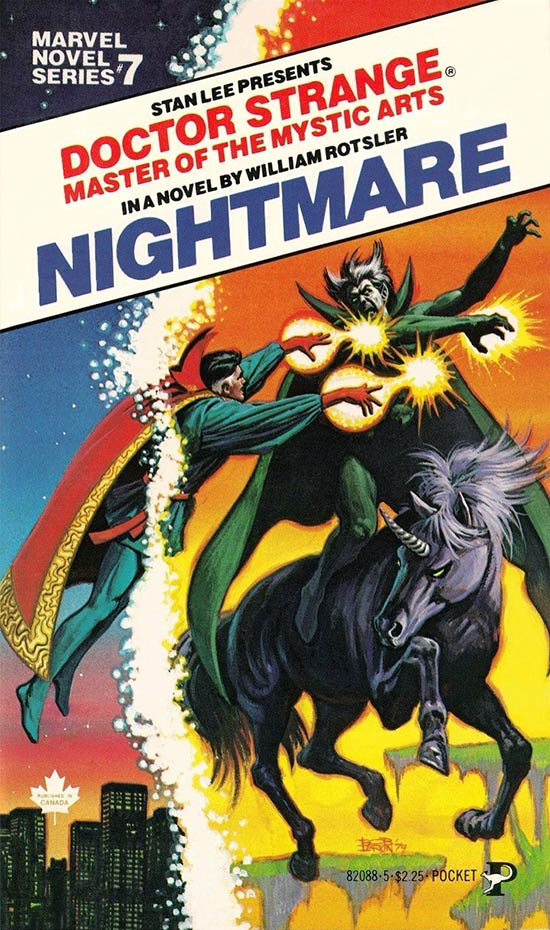
DOCTOR STRANGE: NIGHTMARE "Chapter Sixteen"

If you missed them, Chapters Fourteen and Fifteen are Here!
If you've already read them, please proceed...
Chapter Sixteen

The shadows were deep in the cavernous underground. Only a few lights had been lit, for only a few people were there. Billie Joe was a one-man show, a show with no more scenery than a plain lectern and a simple setting of platform and flowers. It was theater-in-the-round for the Crusade for Change. ’Round the world.

They heard the murmur of the crowd above them, then a squeak as some stagehands began moving some of the rock group’s bizarre scenery. A castle wall was trundled across and set down, blocking their view of the dressing room. Annoyed, Stephen Strange and Clea started to step around the flat, but a second group of stagehands brought in the massive prize ring, set on edge, the canvas covering a tawny wall. Clea gestured at the “castle” gate just in front of them and stepped forward to open it. The painted oak panel swung easily into the blackness; Clea stepped through. At the very last instant Strange sensed something and cried out.

“No, Clea!”

It was too late. The door swung closed and although it was but a moment before Strange shoved it open, everything had changed. No longer was there blackness beyond, but simply the other side of the underground staging area: the dressing rooms, the scenery, a forklift truck, some television people swapping stories.

Strange spun and closed the door after he had passed back through. Quickly, he put his fingers to the Eye of Agamotto hanging at his chest. “O great Eye, pierce the veils of mystery, reveal my student and love to me!”

A light sprang out from the Eye, projecting a beam onto the fake castle door. He saw Clea, not in color, but in black and white, reversed like a negative, floating in the purest white space. He saw her hands gesturing, saw her lips moving but heard no sound.

“In the name of the dread Dormammu! Open the way to the region of wonders!”

The Eye blinked out. It seemed very quiet. The painted stone castle no longer looked painted. Strange reached out; the castle door was heavy now, creaking as it swung heavily open. Beyond was neither blackness, nor the dressing rooms, nor the pure white sea in which his beloved Clea was drowning. Beyond was a medieval-looking corridor of shaped stone, gray and cold. The corridor was lined with archways and each archway contained a thick wooden door; on the face of each door was burned a cryptic symbol.

Strange entered the corridor without hesitation. The incantation had not taken him directly to where Clea was imprisoned and there must be a reason. He was alert, strong spells of protection ready on his tongue.

The first door opened easily at his touch, swinging away to reveal an emerald glade beyond. A well-trod path led from the archway through sunlit grass to a nearby forest of ancient gnarled trees. At the edge of the forest, just beyond a dusting of yellow flowers, a golden-haired woman, young and slim, held out her palm to a white horse with a long twisted spike growing from its forehead. The unicorn snorted and raised its head to look at Strange with a wild eye. The young woman shaded her eyes and frowned. Strange shut the door.

The second door opened into another forest, but this one was dark. Black-trunked trees with somber foliage, shadowed passages between, a lightning-struck tree burned and twisted, rough gray rock, no flowers, only a little grass. Beyond the treetops Strange saw the broken tower of some castle. It was burning. He closed that door.

Crossing the passage he opened a third door. Howling wind sent a flurry of snow into the passage. The cold froze his face as he peered into the wild whiteness. Something huge and dark rose out of the snowdrift and made a lunge toward the door, snarling, hairy hands extended. Strange yanked the door shut but the clawed paws grasped it and wrenched it open again. It bellowed and started through but met a burst from Strange’s outstretched hand. The creature was blasted back, its chest on fire, and threw itself into the snow. Strange slammed the door shut.

He approached the fourth door with even more caution. It was well he did, for the moment the door opened, something wet and splotched heaved itself against the oak. Stephen Strange shoved back with all his strength, but pseudopods of blotched protoplasm flung themselves through the crack and attached themselves to the stone floor. These tentacles split and some curled toward Strange while others extended themselves and stretched toward the farther walls. The door sagged inward. A massive blob of the stained protoplasm bulged through the door.

“By the supreme Satanish!” exclaimed Strange, his fingers moving. Flames suddenly enveloped the tentacles, which jerked, then contracted swiftly. Other tendrils of protoplasm came through the door, but they, too, started to burn. The blood flowed back out, followed by the extended tentacles. There was a thin high whine which wavered and disappeared when Strange slammed the door closed.

The fifth door Strange eyed with apprehension. He looked down the long corridor. It seemed to go on forever. There were hundreds of archways with their recessed doors, each an opening into some odd dimension. It might take him forever—but there was no other way to do it. He opened the fifth door.

Blue sky. Nothing but blue sky and a few faint, distant clouds. Strange looked down. The door opened into the side of an incredibly high cliff. The mountainside dropped for thousands of feet, a fluted granite wall without vegetation, ledge, or sign of human habitation. The origins of the cliff were lost in a thick white mist far below. Strange started to close the door when there was a horrendous screech. A pterodactyl came slanting out of the sun, its long beak open, its long leathery wings flapping. Strange swung the heavy door shut but it shook with the assault of the prehistoric beast as he closed it.

The sixth door opened into desert. Nothing moved; there was the trail of a snake wiggling across the slope of tawny sand.

The seventh door exploded with tons of water the moment Strange lifted the metal latch. He was slammed back into the opposite wall and the water poured in with a deafening roar, spreading out, filling up the corridor swiftly, pinning Strange against the wall.

“Crimson bands of Cyttorak!” he shouted, his mouth filling with foul-tasting water. A green tentacle, one side covered with pulsating suckers, came in and reached for him. “Banish this flood!”

There was a sizzling as scarlet bands arced across the stone archway. Water squirted through the slits, but the bands closed upon themselves, severing the massive tentacle, which lay twisting and writhing on the wet stone as the rest of the water swept on down into the drains and scuppers. The bands sealed themselves across the arch and no more water entered. Strange stood up, weak from the physical assault of tons of water, and closed the door. The corridor was a mess. Strange spiny fish twisted and gasped. Purple seaweed lay in long sinuous lines. The watermark on the walls was almost above Strange’s head.

“Flames of the Faltine!” he exclaimed. There was a searing flash and the long corridor was dry. The bits and pieces of flotsam and jetsam were seared and fell into powder, including the big severed tentacle. Strange’s clothes were dry. He stepped wearily toward the eighth door.

“Clea, Clea,” he muttered.

The oaken door swung open and Strange looked into a treasure chamber in a natural cavern. Ancient rectangular chests had round golden coins spilling from them. Fistfuls of pearl necklaces and armloads of golden bracelets clogged other caskets. A strange six-sided box was open, revealing thousands of tiny glowing octagons of blue metal. A crown studded with emeralds, far too large for any human head, lay atop a shattered crate that held an Aztec statue of solid gold. A spear of transparent crystal was topped with a long metal point carved from a ruby. A cask of silver globes was next to a rotted bag of 1888 U.S. silver dollars. A Wells-Fargo strongbox was next to a studded bronze chest with the graven symbol of King Sumuabi who had ruled Babylonia in its first dynasty more than 4,000 years before.

Three skeletons lay disintegrating among the treasure. Only one was human.

Strange shut the door, took a breath and crossed the passage to open the ninth door.

Stars—but none he knew. A gas cloud loomed red and awesome before him, lit by the light of a million suns. Not far off was a red giant. Just before the door floated a pure-white cube. Strange looked at the cube thoughtfully.

White. Clea had been in a white world, a negative world. The box was small, no bigger than might hold a hat; purest white, featureless, reflecting no starlight. Antimatter? Would that explain the negative whiteness?

“By the seven rings of Raggador,” he said softly, watching the box carefully. “Fetch me that box.” He gestured and seven glowing rings flew from his fingertip, each no bigger than a finger ring, but they expanded to be large enough to contain the box. They wove themselves around the box in an intricate web and slowly tugged the white box closer.

The rings set the box upon the floor and Strange expanded the rings to mansize, a cage of glowing filaments. “Open,” he commanded.

The box opened, but not in the way he thought. The square lid did not swing up, but instead the sides contracted into themselves, until there was but a skeleton of white lines in the shape and size of the box. Within the box, floating in the exact center, was a white ball, smaller than a tennis ball, and featureless.

“By the dread Dormammu, I command you to reveal your secrets!”

The white ball pulsed and turned transparent. Within the ball was a universe of stars; pinpoint dots of light, millions of them, making the ball glow. Peering closer, Strange could see that the dots were not stars but tiny pinwheels of galaxies. It would take him a million lifetimes to search even a portion of it.

“Return,” he said. The ball turned white. The sides of the box rolled down. The crimson bands returned the box to the unknown region of space, and Strange closed the door. He hesitated, and almost reopened the door. Clea could be somewhere in that pocket universe, he thought—but no; her prison was a negative universe.

He stood before the tenth door. He opened it carefully. Beyond was a red-lit sky and a stony path leading over a hill toward distant spires. The road was lined with hundreds of human skulls. On the hilltop a dead woman hung naked, upside down, from an inverted cross. He closed the thick oak door.

Eleven. A burned and ravaged landscape, blackened and savaged by terrible rays which had cut deep gashes in solid rock. The ruins of a domed city still burned. A tall skeletal machine with six jointed legs turned glistening lenses toward him. One of its legs was bent and twisted. There was dust on its black metal carapace and rust at the joints. A turret on its rounded back swung a wide-snouted weapon toward him. Strange slammed the door shut just as the weapon spurted out a stream of liquid fire.

Twelve. The air was a muted dirty orange. Thousands of people in shapeless gray clothing stood apathetically in endless lines. Featureless walls rose above them and Strange could see the bars of light that denoted buildings beyond, barely glimpsed through the thick murk. No one looked at him; no one cared. An old woman gasped and fell. No one paid any attention. Strange closed the hatch.

Thirteen. A mystic number.

Kong was atop the Empire State Building. The blonde woman screamed. The biwinged planes swooped and banked, their machine guns chattering. The great ape roared and swung out a hand, snatching one of the flying machines from the air, crushing it in his monstrous hairy hands. Spots of blood dotted his body. Red gore oozed down his black fur. The great creature reached down and lovingly gathered up the screaming blonde woman. She fought ineffectually against his immense strength. The ape swayed, bellowing. If he fell, he would take her with him.

Doctor Strange was about to utter an incantation when out of the sky came a solitary figure dressed in checked tweed, his Inverness cloak flowing behind him like a cape. “Holmes!” the woman gasped. The hawk-nosed man rocketed around the giant ape, who turned in bufuddlement.

A dark figure ran out onto the observation platform from the elevator, his slouch hat and black cape flapping in the wind. Two .45 automatics appeared in his hands. He began firing upward in thunderous blasts.

The flying man in the deerstalker cap banked sharply and flew in close, pulling the screaming woman from the puzzled gorilla’s grasp. The extra weight pulled him off balance and they fell out of sight, the woman screaming hoarsely. The giant ape stepped down to the observation platform, squashing the shadowy figure with the blazing guns under his foot.

The top of the gorilla’s head opened and a plump young man with a thick droopy mustache started climbing out. He looked over at Strange, his dark eyes gleaming, and made a leap straight toward him. Strange managed to get the heavy door shut just in time.

“Madness,” he muttered, “a realm of madness.”

The fourteenth door.

A forest wilderness, thick-topped trees as far as he could see. A butterfly flopped by and the scale suddenly changed. The butterfly was not a butterfly but a humanoid figure with wings three meters long and rainbowed with color. The trees were not just trees, but towering growths as large as office buildings. Vast thick limbs held out whole villages hundreds of feet over the mossy green floor of a vast forest. The villages were mud and wattle, much like hornet nests, but the edges of the arched doorways and oval windows were intricately carved with designs. Winged figures fluttered from opening to opening. One flopped in, bearing a huge flower. Another rose up, carrying long green grass, which it took to a nest in progress.

Strange closed the door reluctantly. It was a lovely fragile world, but not the one he sought. Neither were those worlds beyond the fifteenth, sixteenth, and seventeenth doors—barren worlds, shattered rock, melted ruins. The eighteenth door opened into an enormous hall with high colorful walls. All across the blue-marble floor were copulating couples, their human bodies glistening with sweat. On a dais opposite the door was a wide throne, flanked by voluptuous women who wore no clothes, but much jewelry. They watched the orgy with impassive faces. Sitting atop the throne was a lounging insect as large as an elephant, six-legged and black-brown. Each long hairy leg was ringed with golden bracelets and a golden band circled its bulging head just in back of its protruding eyes.

The insect king twitched and its limbs went rigid. There was a thin undulating whistle and from arches came muscular warriors in chain mail. Their arms went back as one, and they hurtled black spears straight at Strange.

“Calthor, protect me!” The spears flipped over in midair and arrowed straight at the insect king. The huge creature scrambled to get out of the way, its long legs sending the flanking beauties flying; but it was not swift enough. The spears plunged into its nightmarish body, and the creature screamed. Yellowish fluid oozed forth and the monster flopped over, crashing back onto its carved throne. It twitched and kicked out; then it was motionless. Slowly, the copulating couples stopped. They lay atop one another, motionless, then they began to rapidly decompose.

With a feeling of revulsion Strange closed the door. The corridor was endless. It was infinity itself.

Dr. Strange stood before the nineteenth portal. He had to go on. Whoever—or whatever—had abducted Clea into the white universe might destroy her. Her powers were not those of her mentor. Perhaps she might be able to hold off the abductors, but not win freedom. He had to continue. He could not give up.

Behind the nineteenth door was a tropical island, serene and lovely. Brown-skinned maidens in low-slung sarongs laughed and called out to him from the clear waters of the lagoon. He wanted desperately to go and lie there in the sun and not think, not fight, not struggle against the infinite varieties of evil. But the very thing that gave him his awesome powers was the thing that forced him to close the thick oak door and go on.

Twenty: an emerald city in the distance, a path twisting through flowers, music in the air.

Twenty-one: jungle, fetid and hot. A planet of incredible size loomed over the horizon. Here and there from the thick green jungle a ruined temple or pyramid protruded.

Twenty-two: blackness—and the fetid stench of rotting flesh.

Twenty-three: a blue room with shiny walls, a humanoid male with shaven skull and fiery eyes wearing a lavender jumpsuit. His hand grabbed for a chromed weapon as he snarled defiance.

Twenty-four: a boarded and battened town, weathered and quaint; the Silver Dollar Saloon next to the Apex Hotel. Down the dusty street two horses stood with drooped heads. One horse had a hoof lifted, as if the street were too hot. Nothing moved; a fly buzzed; someone in the saloon laughed.

Twenty-five: a wide-beamed ship with crimson sails emblazoned with an intricate cryptic symbol moved at a slant over swelling waters. The carved and painted woman at the prowl had naked breasts of unexplained fullness and pointed nipples. Her head was that of a feathered bird.

Twenty-six: Strange looked into a cluttered room where a number of people sat on folding chairs. Many were bearded and wore army-surplus clothing. A woman crocheting was the only one that saw him and she blinked in surprise. The others were busy auctioning off parking places in front of the building.

Twenty-seven: Strange stood wearily in the arch. The sun was red, giving everything an odd rusty cast. A fortress was nearby, sturdy and unimaginative, made of red stone and its walls topped with pink points. There were bloody heads on almost every point. At the foot of the walls were skeletons in rusting armor. Black birds flapped near the heads, pecking at shreds of rotting flesh.

Twenty-eight: glistening city, all chrome and crystal and smooth surfaces. Delicate bridges linked domes and pyramids and ziggurats. There were gardens where natives strolled, but the natives were gray-green reptiles in silken robes.

Twenty-nine: moonscape, dead and undisturbed. A planet rose above the horizon and seemed oddly familiar. It stopped Strange long enough for him to recognize the world. It was Earth, a billion years before, when all the continents were one, with cracks just beginning to show. Man had not yet been created, and immense reptiles roamed the volcanic plains.

Thirty: a featureless checkerboard plain that ran to the horizon. Nearby, directly before the gate, was a wide blob of pale jelly. The spots within the jelly stirred and Clea rose from the blob, naked and lovely, her legs and hands attached to the flowing blob. Strange uttered a curse and the blob exploded, sending Clea splashing across the checkerboard.

Thirty-one: a hundred tiny large-headed robots scampered past, each bearing a load of some sort. Buzz. Beep. Brak. Bonk. Beep-beep. A myriad of walkways threaded the city that lay before Dr. Strange. The towers loomed up above the maintenance levels where the robots scurried. He caught glimpses of sky-cars and thin bridges and curly-headed figures strolling slowly, dressed in pastel fabrics.

Thirty-two: a courtroom of some sort. An ancient and wrinkled man in black robes and a tall crimson hat sat above the other six old and wrinkled men in black, who wore blue hats. Above them, on the wall, was a portrait four times the size of a human, only the portrait was of a dog. Before the judges, in chains, was a slender young girl.

“Death!” the judge said and the others nodded. A muscular man in black, masked and wearing a silver chain around his neck, approached carrying a long curved sword. Others in black forced the girl to her knees. One took her hair and yanked on it, stretching out her neck. The swordsman raised high his weapon.

“By the stones of Sarradani! Freeze these men!”

The sword stayed high. The slender girl wrenched her hair free and stared at Strange. “Run, girl!” he said. She leaped to her feet and ran to him. He slammed the door when she got through and turned toward her.

She was cringing against the opposite wall, staring at him with wide eyes. She was blonde and pale, not pretty, but with a certain grace and obviously intelligent. “It is true! They said the Say-tan would rescue me! It means I am a witch!”

“No, no,” Strange said. She cringed as he approached and would have bolted if he moved closer. Strange cursed to himself. He had no time to spend on her. Clea was in mortal danger. “They think you a witch?” he said and she nodded, looking around. He suspected that in a moment she would bolt for one of the doors. Dormammu only knew what might lie beyond. He made a subtle gesture and murmured a few archaic words.

Her manner changed. All fear vanished from her face and she looked around her brightly. “Where is this?” she asked. “It doesn’t look like Radzi or even Quade.”

“No, it isn’t,” Strange said. He put out his hand and she took it. He walked with her back along the corridor a ways and thought: she would like the tropical paradise, but would confuse those who lived there. The same with the door leading to the American West of yesteryear. He stopped. So many were hostile or lonely. The emerald city beyond the twentieth portal, perhaps, only he did not know for certain what might lie there. He shrugged and turned back. “Come with me,” he said.

“All right,” she said brightly. “Where are we going?”

“To where you will like it.”

She screamed when the thirty-third door opened. Beyond was hell, with a clawed, winged creature sitting on a throne of flame.

Strange calmed her with difficulty. The thirty-fourth door was before them and she was trembling, looking across the hall at the closed portal. She took a deep breath and clung tightly to Strange’s hand. He opened the door.

It was like a mirror. They saw themselves, sorcerer and accused witch—only they changed at once. They aged with incredible swiftness. The bloom of youth faded in seconds. Her body thickened and sagged, her eyes grew rheumy, her hair scraggly, and she became putrefaction. Strange saw his own image swiftly age, die, and rot.

“It’s just a . . . a dream,” he said to her as he closed the door.

“But . . . but . . .”

“Yes, I know, it looks real. Well, it is real, but it isn’t this reality. Look, we’ll try another door.”

“What are you looking for?” she asked breathlessly.

“My love.”

The girl looked up at him, sadly, seemed about to speak, but didn’t.

“All right,” she said, squaring her shoulders.

The thirty-fifth door was much better. A kind of Macy’s parade was going by. The street was full of cheering people dressed in bright colors, all wearing some kind of symbol, either in jewelry or woven into their clothes, or embroidered upon them. It was a circle with a slash through it, something like a side view of Saturn. The buildings across the street soared up out of sight, shiny and smooth. Over the heads of the crowd Strange saw windows heaped with strange products: crimson balloonlike things, blue shafts that tapered, green chalky sticks, purple cloth, yellow cubes, white crystals.

But it was the parade that caught the girl’s attention. She cheered along with the others as the entries in the bizarre parade went by. A dragon made of transparent material, floated, bobbing, with a beautiful nude woman swimming in blue liquid within it. A spiny thing like a blowfish, only two stories high, walked on longer spines. A robot, all orange-metal legs and attachments, squirted out rose-colored liquid that hardened in the air and became candy. A tall, dark-haired man floated on a silver disk, dispensing wafers of chocolate-colored something. A troop of Napoleon’s artillery . . . a balloonist in a top hat and burgundy suit . . . a long-nosed green creature who looked solemn and profound and rode in a carriage drawn by enthusiastic human volunteers . . .

When a tall float came by, blaring music, squirting candies, dripping flowers, the girl could not contain herself. She released Strange’s hand and ran through the portal before he could stop her.

Everything slowed and stopped. The light dimmed down through the spectrum until everything was bathed in a sullen red light. The solidifying candies hung in the air, dropping with infinite slowness. The girl herself moved as though in very slow motion.

Time slowed and all but stopped.

Stephen Strange didn’t bother to take the time to figure out why. He brought his hands together and meshed his fingers before him, arms out. “Father Time, ultimate goal of all things, release this child! By the thirteen bells of Bellok!”

The girl moved backward, step by step, until she was again next to Strange. The parade, too, moved backward. The candies became liquid and slowly reentered the spouts. Then the girl’s fingers interlocked with Strange’s and the parade continued forward.

She looked up at him, smiling brightly. “Isn’t it beautiful?”

“Yes, but we must search on.”

“By the way,” she asked as the door clicked shut, “I don’t know your name, kind sir. Mine is Ramma-delforadarra, daughter of Delfor-carra-tumathador and the Cavar of Alcala, Gillum-yeh-jarra.”

“Mine is Stephen Strange.”

“May your yamma always be clear and your hulta dry.”

Strange smiled. “May yours, too.”

She laughed. “Don’t be silly. Girls don’t have yammas!”

“Oh. Well, I’ll call you Ramma, all right?”

“Of course, Stephen,” she frowned. “What else could you call me?”

“Door thirty-six,” he said.

Her eyes widened. “Thirty-six is a sacred number.”

“All numbers have significance,” Strange murmured.

A sunbaked plain, cracked and parched, stretched from the door to the horizon. Horned skeletons that were not cattle dotted the ground. Much further toward the sun was something that looked like a shipwrecked sailing vessel of thin metal.

Thirty-seven: lightning was the only illumination. Blue-black rocks stood up from a motionless lake or sea. Something flopped and disturbed the mirrorlike surface.

Thirty-eight: a small, dark-haired girl in a blue dress was sitting under an immense pink mushroom talking earnestly to an impatient goat. The girl looked up, gestured toward the pink and blue and ocher mushrooms behind her and said, “You can have any of them.” To the goat she said, “You’ve got to try harder, Crollin.”

Thirty-nine: a tall skinny man wearing shabby lavender clothes rode what looked like an Easter egg with hairy legs. He stared at Strange and the girl, then ducked his head shyly. “I’m sorry, don’t hit me, I didn’t mean to stare.” The Easter egg slowly turned its hairy head and neck and looked balefully at Strange.

“Grot,” the Easter egg said.

“Shush, Tremlin,” the tall man said.

“Excuse me for bothering you,” Strange said.

“That’s all right. Oh, wait!” Strange stopped closing the door and looked back. “Would you mind telling me how you know the language? You don’t look like you’re from around here.”

“We’re not,” Strange said.

“We pick up things fast,” the girl said and she closed the door. “He’s an odd one,” she said, and skipped across to the fortieth door.

Beyond was a dry grassy plain. A chipped monolith was standing very close in front of the door. On top was a sphere of weathered stone. On the side facing the arched doorway was an inscription. It looked like Arabic but wasn’t, nor did it seem to be any language Strange knew. Something seemed to be burning; it was in the air. What was burning stank.

Forty-one: an asteroid, hollowed out for living quarters; stars beyond; a couple of good-sized rocks nearby, a small blue-white sun. An airlock opened and out came a wormlike creature in a clear spacesuit. “Ugh,” Ramma said and closed the door.

“How many are we going to open?” she asked.

“As many as we must,” Strange said.

Ramma sighed and looked down the long corridor. “What about something to eat?”

“Soon,” Strange said, reaching for the latch of number forty-two.

It was a lovely world, grassy and graceful. Slender trees rose up in small groves, with larger ones beyond. They had limbs that spread out into a many-fingered support for what looked like uneven ovals of thick moss. Broad-leafed bushes were giving birth to bright-colored flowers. The green grass sloped down to a small bay, an inlet of a wide lake. Purple mountains were on the other side. A dock of shaped stone stuck out into the bay and there lay a wooden ship of closely fitted timber. The bright red sails were furled and on the decks were broad-shouldered humanoids loading bales of pressed flowers and baskets of seeds and nuts.

A Strange and Ramma watched, a number of humanoids came out of the forest and toward the ship, singing and dancing. They played stringed instruments, had no clothes except thick striped socks and were bald except for elaborately arranged topknots.

“They’ll have something to eat,” Ramma said. She started forward, then stopped and looked at Dr. Strange. “May I?”

Strange searched the landscape before him. On a headland across the lake was a round-topped tower of rose-colored stone. There seemed to be no weapons. The singers and dancers had sighted them and were staring, not in fear or surprise, but as if they thought they should recognize Strange and his companion, and didn’t.

“All right,” Strange said. “You’ll be all right here, go on.”

She gave him a dazzling smile and ran out happily. Strange watched her join the throng of singers and they seemed to accept her without reservation, though a few plucked curiously at her clothing. Strange shut the door slowly and took a step away. He stopped, feeling just a touch apprehensive, and stepped back to pull it open again. Everything had changed.

The young saplings were now tall, thick-bodied trees. The tower of rose rock was now three towers, with walls between. The stone dock was still there, but much mossier. There was no ship, nor singers or dancers. There was only one very old woman, in a dark-blue robe, sitting on a wooden seat in a circle of paving that had not been there seconds before. She seemed to be asleep.

She trembled, then awoke with a start, looking around until she saw Dr. Strange. “Stephen!” she said. “I knew you’d come back some day!”

Strange blinked. “Ra-Ramma?”

“Yes, of course.” She peered at him carefully. Her hair was gray, shaved into a topknot and bound with blue ribbons. “Why, Stephen, I don’t think you’ve changed a bit! I knew you were a magician!”

“Ramma, I . . .” There were so many questions.

“Oh, I wanted to thank you for bringing me here. It’s been so nice. I have forty-nine grandchildren, would you believe that? My first son was named Stephen, you see. He died, of course, fighting the screamer.” She gestured toward the tranquil lake. “We’re all very proud of him.”

“Ramma, you’re . . . you’ve had a good life?”

“Oh, the best, Stephen, the very best. No one here hates anyone . . . unless, of course, they’ve made a perfect yakka of themselves and then you’d expect that, wouldn’t you?”

Strange smiled. “Ramma, I’ve got to be going. I’m still searching for my love.”

“Oh, you’ll find her, Stephen. I just hope she’s not an old yulla like me, though.” She sighed deeply. “I do wish I could go shell finding again, out by the silver rocks. Well, I had my share.” She looked at Strange and her toothless mouth bent in a smile. “Good yallooning, Stephen.”

“Good yallooning, Ramma.”

“Oh, you silly person. I can’t yalloo.”

Strange closed the door and sighed. The forty-third portal was before him. He was reluctant to open it. There seemed to be an endless number of dread fates just beyond the mysterious oaken panels. He reached out, opened the door and slammed it shut before it was open more than a few inches.

The entire opening was a mouth, pink and wet, with a long snakelike tongue that darted toward him, slapping the closing door with a great flapping sound.

Stephen Strange took a deep breath and stepped to the next door. He glanced down the hall. It diminished in perspective until the walls seemed to merge. There were an infinite number of arched doorways set in stone walls.

Forty-fourth. He was on a balcony, looking down into a small town. There was some sort of bazaar on the street that passed below. Striped awnings alternated with others sewn or dyed in bright artistic blotches which shaded the sauntering natives from the harsh yellow sun. A tanklike machine rumbled past, raising a little dust. A dragon the size of a large horse limped along wearily, pulling a two-wheeled cart in which lounged a fat man in a purple robe and a conical blue hat. The cart was filled with long, slender blue fish. Fat-domed pots held fires and brown-skinned women sold black sausages to passersby. A tall man in leather armor led a coffle of slaves along the street, their necks linked by a chain. The slaves looked hungrily at the sausages. An unusually tall woman with balloonlike breasts and a towering crimson headdress strode by and was deferred to. An artisan hawked pots in the shape of a multibreasted woman. A helmeted soldier with a long sword casually slapped a child out of his way. The child tumbled, but did not cry, and quickly scurried into the crowd.

Strange closed the door. The universe was indeed a varied one. The forty-fifth door showed a large brown-orange desert seen from a high angle. Thick towers were all around, but most were in a state of advanced decay, cracked and crumbling. A muddy stream, not much more than a trickle, wandered through broken walls. A red-robed priest knelt on a prayer rug, disemboweling a cat.

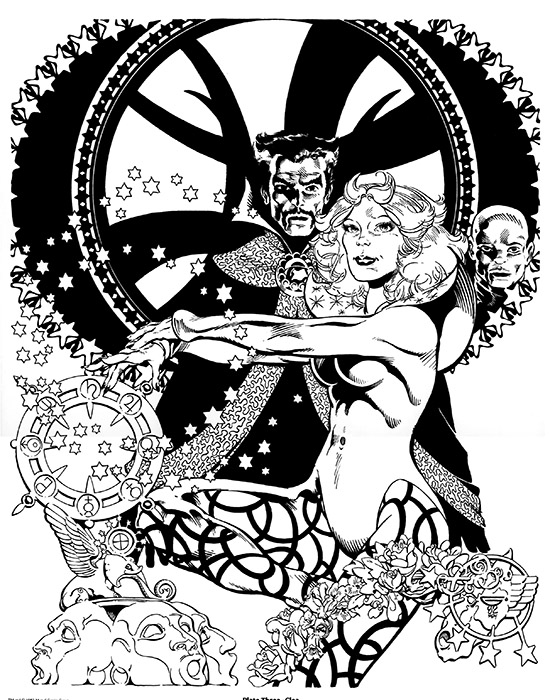
No Clea. Strange leaned against the wall and thought. Would Clea’s odd origin have any bearing on where she might be?

To Be Continued...Right Now...

Tuesday, August 23, 2022

DOCTOR STRANGE: NIGHTMARE "Chapters Twelve & Thirteen"

Catch up with Chapters Ten and Eleven Here.
After that (or if you've already read them), continue...
Chapter Twelve

“No, Mrs. Jacks, I don’t think normal medical help will aid your husband,” Strange said into the telephone mouthpiece. There was a pause and Alicia Jacks sighed.

“I don’t know what to do, Doctor. He’s . . . different; caught up in this new crusade. We’re going into something very big, you know. The Crusade for Change? You’ve heard of it?”

“It’s been on all the media, yes.”

“Going by television satellite all over the world practically,” she said proudly. But the pride quickly gave way to the fear she had expressed to Strange. “He’s sleeping, but . . . it’s not the same. He . . . he just sleeps. We don’t . . . I mean, he goes to bed early now, and sleeps very solidly, except . . .”

“Yes?”

“Well, umm, it’s not that he talks in his sleep, you know? But he . . . he makes sounds. Threshes about. As if it were a nightmare, except I . . . I can’t wake him up!”

“You’ve tried?”

“Yes, but . . . he just doesn’t respond; at least not until he’s ready. Then he’s up and going and full of plans and things to do.” She hesitated a bit. “Doctor Strange, it’s . . . it’s very odd, you know? He’ll say, ‘I’ll sleep on it,’ kidding like and then he really does. Mel Knowles—that’s our coordinator—wants to know about this or that and . . . and he’ll have to wait until the next day. Then Billie Joe, he’ll have a real precise answer.” Her voice brightened. “But things are coming along real nice, you know? Got ourselves a marvelous network connection in Brazil. Brazil—imagine that. They speak Portuguese there, you know, but I guess enough speak English. And there’s a possibility of Sri Lanka and bits of East Africa, too, by satellite relay. We’re just, well, spreading all over. This crusade is going to be just, well, just terrific!”

“I’m glad you’re happy, Alicia.”

A pause, then Alicia Jacks said, “I just hope this is going to be all right.”

“What do you mean?”

“I’ve . . . I’ve heard him rehearsing his speeches. He used to do them for me, you know? But now he rehearses behind closed doors. But I’ve heard things and . . .”

“Go on.”

“It’s a different message. I know he says he’s seen the word of the Lord, that this is a Crusade for Change and he will be offering that change. He’s a good man, Doctor Strange, y’know?”

“Why is this new message different?”

“I . . . Lord knows, I . . . it’s just . . . I can’t put my finger on it, Doctor. But every day he . . . well, he looks a little bit worn out. This is going to be a great strain on him. He’s not a kid anymore, you know? But he thinks he is or acts as if he is. Drive, drive, drive, he says, but I don’t know. It’s wearing him out.”

“Do what you can for him, Alicia. See that he gets vitamins and eats well—and sleeps well.”

Strange looked at Clea, who looked back from behind hooded eyes. Alicia Jacks apologized for bothering Strange and quickly rang off.

“Jacks is just one man,” Clea said.

“And Joe Peerson is another—also that mysterious marksman,” Strange added.

“A pattern will emerge, Stephen. You’ll see it and act on it.”

“If I see it in time,” he said.

Chapter Thirteen

Strange lay awake in their big bed. Clea was asleep next to him, a satin sheet barely covering a curving hip. The constant murmur of the city outside was barely heard in this shrouded chamber. A stub of a candle still burned, putting highlights on the polished carved wood.

Stephen Strange’s thoughts were troubled in the way they are when a name or a fact one knows, but cannot quite remember, hangs there, just out of recognition, tantalizing and annoying. There was some sort of pattern in all this, he thought. There had to be.

That is something for another time, he thought sleepily. I’ll think about it . . . tomorrow . . .

Sleep came quietly.

Drifting . . .

Fragments; color; whispers; part of a wall; a line from a spell about transmutation; the shrouded faces of vanquished enemies; a gray plain; walls, walls, more walls . . .

Strange was walking along slowly next to a wall, looking around in bemused bewilderment. Where was he? What was this? Why was he here?

The walls were gray metal and very high. Above them he could see the stark angles and planes of a mechanized city. Dark ports opened, cold blue lights snapped on, metallic creatures flew into them, the ports closed. A thin black line etched itself into a rectangle, the rectangle swung open, and a silver-domed human stepped out. He looked at Strange curiously, shrugged and walked on. The rectangle closed. Strange watched the man with the silver head turn and walk through a gray metal wall. A black sphere floated into view between the tall gray buildings, then sank out of sight.

Strange stopped with his back against the cold gray metal wall. Why was he here? He couldn’t seem to remember exactly why he had come there. Or who he was, except in a vague, uninterested way. A port opened near him, creating itself out of nothing, and a slender young woman stepped out. Her head was hairless and the top portion of her skull was smooth silver. She glanced at Strange, seemed indifferent, and walked on. She wore snug-fitting gray clothing and Strange could see the play of her muscles and the sway of her long gray tail.

Tail?

Another black sphere floated into view between the buildings, grew closer and settled down between Strange and the next wall. It was as big as a small house, gleaming black, and heavy. A crimson line appeared, circumscribing a perfect circle, which swung out. A pinkish light illuminated the person who stepped out from the sphere. It was . . .

It was . . .

Strange knew he knew the person, but he couldn’t quite see what he or she looked like. If he could actually see the person, he knew he would know who it was. It wouldn’t be difficult. All he needed was a good look . . .

It was . . .

The person crossed the space to the nearest wall and melted into it and disappeared. The plug in the black sphere closed and the ball shape lifted and soared away between the dull metal towers.

Strange walked on . . .

. . . down a hospital corridor. A green-clad surgeon hurried past, followed by attendants moving a gurney upon which a figure lay under a red blanket.

Blood.

Gaping mouth, staring eyes . . . gray skin . . . the color of death . . .

“Strange . . .”

The face moved, the eyes stared, already filmed with the gaze of death. “Strange . . .”

He bent over, the gray bony hand clutched at his shirt front. “Strange ..

“Yes, what is it? What can I do for you? I’m a surgeon.”

“Strange . . .”

“Yes!”

“Strange . . .”

“Yes?” he said wearily. It would go on forever, a cycle of frustration and fear.

He pulled loose from the grasp and strode into an operating room. A nurse put a scalpel in his hand. He put the sharp edge of the tool against the smooth, flawless flesh of a body . . .

. . . blood . . .

. . . Clea . . .

. . . he wielded death in his hand, life and death, but he chose death. Others had died under his hand. He had tried desperately to save them, when he had been a surgeon.

She was dying, this woman he loved. He could not stop it. With all his powers he could not stop the hand of death.

He drew back the scalpel. The blood flowed backward, the flesh closed . . . He could do it . . . The room changed, then changed again. It was chaotic and confused. A long gray corridor . . . mirrors that reflected things that were not there.

He awoke suddenly. There was a siren off in the distance, its shrill note rising and falling, a deep-throated horn blaring. He wiped sweat from his face and looked at Clea. She had turned on her back, the satin sheet stretched tight across her lower hips. She looked beautiful. There was no incision across the soft smooth flesh of her stomach.

He had difficulty going back to sleep.

To Be Continued...Right Now...

Monday, August 22, 2022

DOCTOR STRANGE: NIGHTMARE "Chapter Nine"

If you haven't already done so, read Chapter Eight Here, then continue...

Chapter Nine

Steven Strange felt weak. The assaults on his astral body had required massive energy for him to defend himself. He felt drained and hazy. It was time to go back to the realm of the undreaming, he thought. He turned, spreading his cape, preparing to go back through the planes of unreality to the dreaming mind of Billie Joe Jacks.

“Winds of Watoomb! Take me to the portals of reality!” But before Strange could make the confirming gesture of execution, his world exploded.

White-hot heat struck him, followed by searing, numbing cold. Winds whipped the clouds around him, tumbling him, sweeping him along. He fell, pinwheeling through nothingness . . .

. . . blackness . . .

. . . sparks of fire exploded into quivering spheres of pale light.

. . . pain plucked at his senses . . .

. . . flame . . .

A spider as large as an elephant grabbed him in sticky, hairy claws, pulling him toward a beaked mouth dripping with saliva. The bulging beaded eyes glared, the ridged beak gaped—

“Mighty Tarag! Destroy this apparition of evil!” The fingers of his imprisoned arms flexed and the spider spasmed and dropped Strange. The hairy black body quivered, then split open in a bloody cleft. From the rupture slithered a luminous snake, its scales shining, its reptilian eyes hooded. The forked tongue slid out and back and the hiss drowned out all other sounds. The creature reared back its head, fangs glistening, and struck down at Strange, who was but a tenth its size.

Strange rolled aside. There was red rock under his body, hot red rock. The snake’s head brushed Strange in its attack and the ivory fangs gouged twin grooves in the stone.

“Haggor!” Strange cried, stretching out his hand as the giant reptile pulled back for another strike. “Haggor, save thy servant!”

A hissing fog boiled, blindingly white, from Strange’s fingers, and foamed over the snake. The serpent twisted and hissed as it disappeared in the roiling mist. For a second all was obscured—the ruptured carcass of the spider, the coiling snake, the flames beyond. Then the fog melted away and yet another savage creature stood poised to attack.

It was a man shape, covered in snakeskin, heavily muscled, eyes white, without pupils. He moved gracefully, almost sinuously, as he dodged an instinctively aimed bolt of light fired from Strange’s outstretched arm.

“No good, Strange,” the man shape said. There was a forked spear in his hand and he hurled it. The moment it left his hand another appeared. The first spear sank into the hot stone next to Stephen Strange as he scampered to his feet. The second and third spears were turned aside with a flick of Strange’s fingers, as the sorcerer studied the creature before him.

In the long career of Dr. Strange, he had met numerous enemies in many guises. Some took the images of monsters, imposing humanoids, devils, and demons. Others sought to deceive him by assuming the persona of nonthreatening beings and creatures, to allay the fears of their enemies by misdirection. Yet all, in some manner, were projections of evil, of greed, envy, and lust for power. There was no doubt in Strange’s mind that this snakeman was also the physical manifestation of some sort of evil.

The snake creature continued to hurtle spears and Strange continued to turn them aside. Then, with disconcerting suddenness, the snake thing smiled. Fangs showed, dripping with poison. The creature laughed—a hoarse, wheezing snort of triumph.

“By the—ahh!” Strange’s fingers contracted in pain and he clutched his injured hand to himself. As he had been about to abolish the snake thing, pain had struck. He looked around in confusion. The spell he was about to evoke was one of the best, an invocation of the Vishanti, a protective incantation that would fire enemies into a nether world.

But it hadn’t worked and as he looked he saw why. The forked spears he had so carelessly shunted aside had plunged into the hot rock in a carefully designed pentagram around his astral body. He was imprisoned and helpless. He heard a rumbling laugh and looked quickly at the snake man to see the beginnings of the metamorphosis.

The green-scaled skin became slack, sloughing off into long shreds of emerald, revealing beneath, a lean body of green flecked with black. The discarded strips of skin became an odd cloak, fastened at the wrists and streaming back to join a wider panel hanging down from a high dark collar.

White skin . . . gray, untidy hair . . . bulging, staring eyes . . .

“Nightmare!”

Insane eyes glittered as the smile of triumph spread across the dead-white face. “Strange,” he said, his voice the howl of midnight wind through the canyons of the mind.

An ancient enemy. Strange’s earlier premonitions had been correct. It had not been Mordo or Zota or any of the dark forces he had met early in his revitalized career.

Nightmare!

The lord of the dream dimension, the tyrant of the occult divisions that lurked beyond the walls of sleep. Time and again it had been Doctor Strange and only Strange who stopped the supernatural creature from invading and controlling the world of man by controlling his dreams.

Now the supernatural sorcerer had trapped Strange within the powerful pentagram, the basic symbol of all magic, black or white. Strange knew he could not pull the spears from the hot rock; that he would not be able to take the pain nor would he have the strength. He was trapped.

“What is it this time?” Strange said. “The same sad attempt at invasion?” He looked at the figure of Nightmare, his face in an expression of aloofness and disgust.

Nightmare laughed. His green cloak billowed in the hot winds. They were in a hellish landscape. Volcanoes spat fire and molten rock; hot puddles of lava bubbled nearby. Ebony smoke polluted the sky; flames sputtered up from a hundred cracks in the rusty soil. Distantly, there were screams and cries. It was not hell, but a localized imitation, and Strange knew it. It all existed in the mind, the dreamland of Billie Joe Jacks. Yet . . . that dream connected to the dream dimension, drew from it, was controlled and inspired by it.

“This time it is different, Strange,” Nightmare sneered, his mad eyes staring lecherously.

“No,” Strange countered. “You have been defeated before; you shall be defeated again.”

“Not by you, Strange.” He gestured and lava broke the surface nearby, burbling up through cracks, flowing down the rock toward Strange. It came on relentlessly, steaming, crusty on top where it was relatively cooler—red-centered, burning, the molten heart of a planet bursting forth.

Stephen Strange did not hesitate. He pressed his long fingers to his temples. “In the name of Haggor, by the powers of the darkness beyond the darkness, protect thy servant!”

The lava seemed to naturally flow to one side or the other, steam rising, searing the rock beneath, flowing past the spears stuck in the rock, creating a little island in the stream of molten rock. Nightmare’s eyes blazed and with another gesture he caused a thunderclap over Strange’s head.

The roiling black smoke parted and down from it, screeching shrilly, came a thing right out of a madman’s nightmare. The flames lit its leathery wings with red as it plunged down, its outstretched claws like scimitars, its beak like the gouging mechanical maw of a dredging crane. Strange instinctively crouched, not from fear, but to draw the thing below the level of the topmost tips of the spears, into the magical dome of force that imprisoned him.

The screeching bird of prey was Strange’s way out—if he lived.

The swordlike claws raked at him, the great batlike wings beat the air above him, the shrill cries assaulted his ears. Strange ducked, avoiding the first and second strikes of the razor-sharp claws; then he leaped.

The winged creature was the size of a small airplane. When its extended claws brought the foot below the tips of the spears Stephen Strange leaped and grasped the scaly leg.

“Oshtur! Haggor! Part the way!”

The bat wings fluttered as the creature tried to stay airborne against the sudden weight. It rose above the pentagram of spears and the spell vanished. A spear was bent, another ripped from its rocky socket, as the mighty wings beat the smoky air. Strange pulled himself up against the furry underside of the monster, clinging to the leg, avoiding the vicious slash of the other foot.

Strange could not have escaped by himself from the imprisoning pentagram, but he who had created it—Nightmare—had sent in something that could lift him from the dome of force.

Dr. Strange drew back his hand, fingers together like a blade, and cried out, “By the dagger of Cim!” Then he plunged his hand into the breast of the creature above him. The screeching escalated into a deafening cry and then suddenly Strange was falling, for the bat-winged monster was gone, with the suddenness of a dream.

He fell to the red rock and saw Nightmare swinging his arm toward him. Green bands flew out, expanded, became an emerald net. Strange gestured in return and the net dissolved at the joints, becoming motes of light which lost their pattern and drifted away to die.

Nightmare uttered a harsh cry of anger and the volcanoes beyond belched their fiery contents. Ash and lava rained down and Strange crossed his hands over each other, creating a dome of white light above himself.

“The twelve moons of Munnipor! The sixty aspects of Serenity! The hundred and forty-four seals of Agapotti!”

The volcanoes stopped and their cones melted into the red soil and the soil became flat and smooth. The bubbling lava ceased and spread itself thinly. The broken and bent spears wilted into the smoothing plain. The smoke drifted up and away.

The dreamworld was silver and flat, extending to the horizon and up into the purple night. Nightmare’s reflection on the shiny plain beneath his green-clad feet was warped and bent. He uttered a curse and a ripple swept across the silver plain like a tidal wave, rising, threatening to engulf them all.

“Aggari! Shanshor-tillmonti!” Strange said in a dead tongue. The tidal wave drooped and melted into the silver plain. But Nightmare gestured again and from behind Strange, rising like the heads and necks of prehistoric dinosaurs, came ripping up five tentacles. The tips of the tentacles split and parted to reveal dagger teeth. Strange turned to protect himself, and when he turned, Nightmare launched a beam of light from each finger. The beams solidified and became golden bands which wound themselves around Strange, holding him helpless for the five striking heads.

“Shagorri!” Strange exclaimed. “By the powers of the nameless stone of Shagorri, I banish you!”

The golden bands melted. The attacking silver heads withdrew into the featureless silver plain. Strange staggered. He was exhausted from fighting his way through wave after wave of the creatures Nightmare had sent against him. It was Nightmare’s realm and he drew power from it. Strange was an invader, far from his physical body, extended out into the dream dimension, weakened by the demands upon his energy.

“By the eternal Vishanti!” he said and gestured. Nightmare froze. The last ripples where the monster heads had sunk into the silver plain grew smooth. The sky cleared, horizon to horizon, then everything faded.

To Be Continued...Right Now...
at

Sunday, August 21, 2022

DOCTOR STRANGE: NIGHTMARE "Chapters Six & Seven"

Don't worry, we didn't miss Chapter Five!
It's right Here!
Once, you've read it (if you haven't already done so), proceed with us through the Multiverse...
Chapter Six

Both Clea and Strange turned as they heard the chimes. Someone was at the front door. They saw Wong cross the parquet, then reappear in the doorway. “Master, there is a woman here, the wife of a minister of God.”

“Give her something for whatever charity she represents,” Clea said, but a motion from Strange stopped her.

“No, Wong, send her in.” He seemed oddly alert, almost like a dog ready to pounce.

In a few moments a pleasant-looking woman came into Strange’s study. She looked at the two across the room, at their odd clothing, then around the room itself. Strange smiled faintly. To the uninitiated it was a . . . strange . . . room. There were bookcases, but instead of containing the latest bestsellers or coffee-table-type volumes on chic subjects, there were thick books bound with heavy board covers sheathed in carved leather. There were scrolls that looked as if they would crack if you touched them, and crumble to dust if you opened them for the first time in hundreds of years.

Instead of bric-a-brac there were skulls bound in golden bands, their tops gone, and filled with . . . odd things. There were a few stoppered jars, a bust carved in marble, another cast in burnished silver and embossed with golden medallions about the base. Instead of family photos, there were framed portraits of holy men, and one, prominently displayed, of a very old Oriental. On a pedestal that looked as if it were carved by a madman, depicting curling dragons and reptilian forms, was a smoky sphere.

The woman looked again at the two waiting people. Clea was beautiful, although much too provocative to suit her tastes, with stark white hair arranged in hornlike shapes on each side of her brows. A medallion hung between her breasts and there were ornate rings on her fingers. But it was the man who commanded her attention.

“Doctor Strange?”

“Yes, Madam?”

“Doctor Stephen Strange?”

He smiled and inclined his head. He was not young, though far from old, she decided. Handsome, but stern, wearing a mustache, and his temples were white—but his clothes were indeed startling and discomforting to the middle-aged woman. He wore a bright blue tunic over blue tights, and a red cape with a cowl that flared up with what she thought was unnecessary drama. The cape was edged in golden embroidery and held together at the throat by an odd large medallion.

“Come in, sit down,” he said. “You are—?”

“I’m . . . Mrs. Billie Joe Jacks.”

“Ah,” Strange said.

“You . . . you don’t know who he is, do you?”

Strange smiled. “A minister of God.”

“Yes. He . . . uh . . . we are on television mostly. From our . . . our Temple of Light, you know.”

“Go on.” His eyes seemed to envelop her. She felt her nervousness disappear.

“You don’t remember me, do you, Doctor? I mean, you look so different, I wasn’t certain, and I know it’s been years and the good Lord knows I don’t look the same, but—”

“Alicia Lubbock,” he said, remembering.

“You remembered!” She beamed at him.

“You were my patient years ago. You had a most difficult time.”

“You gave me a new heart. Doctor Barnard was just beginning to do the transplants then, and you saved me . . . for the Lord’s work.”

“It was not so happy an occasion for the young accident victim whose heart we utilized,” Strange said. “But that is not the reason you came here.” Strange was sometimes made uncomfortable when reminded of those years spent as a highly paid and arrogant surgeon.

“It’s my husband. You know, Billie Joe?” Strange gestured for her to go on. “He . . . he’s been acting very, excuse me, but acting strangely.”

“In what way?” Strange asked softly.

“He . . . he has these dreams—nightmares, really. He . . . says things. I can’t quite get it, but it . . . it doesn’t sound good to me. Oh, he’s had dreams before, you know, everyone does from time to time.” She looked around apprehensively. “But these are different, you know. And he’s been acting differently.”

“In what way?” Clea asked.

“Well, after one of these, well, nightmares I guess you’d call them, after one of those he’s . . . just different. Even his sermons are different. He used to, you know, preach the Good Book pretty straight. Not Fundamentalist, you understand, but a good solid Christian doctrine. We have quite an audience, all over the world.”

“You assist him?” Strange asked.

She nodded. “Offstage and on, if you follow me. I used to help prepare his sermons . . . You know, do research, look up the quotations to help make a point, that sort of thing? And I lead the Celestial Chorus . . . That’s our choir. But lately . . . well, lately Billie Joe’s been doing his sermons all himself, every word. He used to read them to me first, you know? Sort of test ’em out? But not anymore.”

“What is it you want us to do?” Strange asked.

Mrs. Jacks looked uncomfortable. “Well, what I’d really like is for Billie Joe to go to one of them head-shrinkers, you know? Psychiatrists? But he’d never do that. He said a man ought to have his head examined going to one of them fellas.” She smiled briefly. “But I remembered you, Doctor, and it isn’t all old memories, either. I’ve . . . heard things about you. I think you might be the one to help my Billie Joe.”

“I’ll do what I can, Alicia.” Strange smiled warmly and took her hand. “Can he come here? Soon?”

“Well, we’re in town for a meeting.” She flashed another brief smile. “A kind of religious summit, you might say. Billie, he says we oughta meet on Zion, over there in the Holy Land, but that might give us all snooty ideas.” She flashed another nervous smile. “Doctor Strange, I . . .”

“Go on, Alicia.” His eyes bored into hers.

“You’ll see him then?” Strange nodded.

“As soon as you can get him here.”

“I’ll have him here in an hour.”

“Not in this traffic you won’t,” Clea said.

“An hour and a half then,” Alicia said stubbornly. “He’ll come or I’ll . . . I’ll . . . do something!”

Strange smiled and took her elbow. “As soon as you can, then. We’ll be waiting.”

The moment Alicia Jacks had gone, Clea turned to Strange. “Stephen, what was that? The next thing you know you’ll be taking house calls.”

“If I must,” he muttered as he went back into his study. He sank into his big chair with such an expression of intense concentration that Clea knew better than to discuss it further.

Chapter Seven

“By the rocks of Arrak, Alicia, I certainly do not need any mumbo-jumbo charlatan in my life!”

“Now, Billie Joe, you just get right in there. Doctor’s been waiting on you.”

They came through the door into the study, ushered by the silent Wong, and Billy Joe Jacks took in the arcane furnishings with a frown. “Where’s your bell, book, and candle, Strange? Where’s your feather mask and your rattle, eh?” He flicked his fingers at the thick, heavy cover of a fat old volume atop a pile on Strange’s desk. “What’s this, eh? Some sort of law book about deals with the Devil, huh?”

Strange said nothing, but his study of the evangelist was very complete. Doctors can learn a great deal more just by looking at a patient and feeling his skin than the layman thinks. Strange crossed the room and courteously extended his hand. “I’m Stephen Strange,” he said. “This is Clea, my assistant.”

“How do you do,” Billie Joe Jacks said listlessly. He accepted Strange’s offer of a chair and sat down, followed by Alicia, then Clea, nearby. Strange stood, studying Jacks. He appeared exhausted, irritated, and nervous, the latter manifestations caused perhaps by the first.

“I’d like to ask you a few questions,” Strange said.

“Go on, get it over with; then I can go home. Well, back to the hotel, anyway. Sometimes it seems as if I live in hotels!”

“How do you feel, generally?”

“I feel fine. A little tired, maybe, but I’ll be up for the meeting. Jet lag probably. The work of the Lord is not always easy, you know.” He glared at Strange, who thought his eyes red. “But just get me out there in front of those cameras and the will of the Lord comes into me, guides me, makes me his tool!”

“Billie Joe’s extraordinarily good, you know. Not everyone can use a camera like he can,” Mrs. Jacks said softly.

“Not sleeping much then?” Strange asked casually.

“No, but there are a lot of things brewing. We just might get a consolidation with the Brotherhood of American Protestants; will that be a thorn in the side of Satan! Then there’re the overtures from Pope John Paul—the Pope, no less! He’s had the Archbishop of Canterbury over. He’s talking with others, so why not Billie Joe Jacks, eh? Big things afoot, you see? We’re going into Brazil with our syndicated programs, both radio and television. Brazil, mind you! Lots afoot, lots cooking, as they say. Working for the Lord. Putting it all together. Making it work, eh? Isn’t that the American way, eh? Getting folks to work together? Doing the work of the Lord!”

Jacks’s voice had risen and grown stronger during his monologue, to the point where Stephen Strange saw the power this man had. It was the power of a magnetic personality with a belief. It was a strong power, belief, even if what he believed was not what Strange believed and knew to be true. But it was definitely a power to persuade. Strange leaned forward, his fingers toying with the great medallion around his neck.

The medallion was the Eye of Agamotto, the most powerful physical legacy that the Ancient One had given Stephen Strange.

The evangelist talked on . . . Conversions . . . miracles of faith . . . numbers . . . believers . . . testaments . . . gigantic encampments . . . revivals of the spirit of God . . . movements sweeping the nation with Billie Joe Jacks leading them, focusing their energy . . .

His voice slowed. Alicia’s eyes drooped and suddenly she was asleep. But Billie Joe continued. “This summit meeting, this locus of temporal power, this . . . will . . . bring together . . . the most powerful of . . . of all the . . . the factions . . . heal our divisions . . . with the . . . the blessings of . . . of the . . .”

Abruptly his head dropped. He was asleep. Gently, Strange moved his head back to a more comfortable position. The Eye had done its work. They would be asleep as long as needed for his explorations.

Stephen Strange sat back in his chair and gave Clea a quick smile. He knew what he was about to do made her very nervous. When Stephen Strange projected his astral form out of his physical body, that body was helpless, totally vulnerable. If someone were to kill the physical body of Stephen Strange, his astral self would be lost forever; forever doomed to roam in strange dimensions. Here, in his Greenwich Village home, the place he called his sanctum sanctorum, he was relatively safe. But it still made Clea nervous and he smiled inwardly to see her setting herself to be the guardian of his lifeless husk. Clea had powers too, and, although not nearly as powerful as Stephen Strange, she was not to be discounted, either, as many had discovered.

He closed his eyes and relaxed his body. The trance took only seconds. He rose up almost at once, glancing down to see his mortal flesh slump slightly. Invisible to all, including Clea, he curved through the air, near the carved, wooden ceiling beams, and dove into Billie Joe Jacks’s dream.

To Be Continued...Right Now...
at

Saturday, August 20, 2022

DOCTOR STRANGE: NIGHTMARE "Chapter Four"

Read Chapters Two and Three Here...
...then continue on with this long-OOP truly multiversal tale from 1979!
Chapter Four
Joe Peerson tossed and turned on the bed. Beatrice Marx looked hopeful and snubbed out her nineteenth cigarette. But the prizefighter just grunted and made a series of little uhs and ohs. Lord only knows what he is dreaming about, she thought. The big match, she supposed. Damn his trainer, anyway. After next week, no more hanky-panky. Going into training, he said. No women, no booze, no nose candy, no nothing except hard work for six weeks. This could be her last night with him. God knows you almost have to book yourself in advance, she thought with an expression of distaste. If they only knew in Philadelphia what she did on her little trips. She always returned aglow. “Lost weight, haven’t you?” Adele always said with a smug smile. If the bitch only knew how Beatrice Marx lost weight she’d explode!

Except tonight—no weight lost tonight. What was he dreaming about?

The ring was huge. Still a ring, ropes and everything, but big. Some kinda audience out there in the dark, breathing, waiting. The champ was going to come in. He sensed it before he heard the noise, the cheers. The champ.

He came down the aisle with a spotlight on him. Couldn’t see the people, but he saw the champ. Wore a red cape, had blue trunks, had that hair combed up with the silver streaks on the side. Old for a champ, but undefeated—maybe undefeatable.

He came through the ropes, ignoring him. Psych-outs don’t work, Joe Peerson thought, only fists. The ref was a big guy, and he too wore a cape, a green cape. Well, ya gotta have a gimmick. The ref was out to make a rep, that was all. He touched gloves with the champ, only the champ didn’t have boxing gloves, only pale hands. You can’t do that, Joe thought. Hey, ref, lookit there!

But the ref didn’t hear and the bell sounded and the champ was hitting him, one-two-three, pow, hurt. The champ’s eyes were burning, burning, hot and angry. It wasn’t fair. The champ’s punches hurt—bone on flesh—but his were padded, ineffective. He looked at the ref, but the ref was laughing, his unkempt gray hair shining in the light, his face shadowed, though the eyes glowed.

Eyes, laughing at him, humiliating him . . .

The champ reared back, his fist cocked. There was nothing he could do to stop it. He was helpless. The fist came at him, pale and hard, and exploded him right out of the dream.

“Well, I never—!”

There was a woman in his bed, grasping at the blankets to cover her pale nakedness. Joe Peerson stared at her wildly. He didn’t know who she was, but she was a woman, and he needed a woman. He needed to forget.

But even as she gasped under him, a wide smile on her face, even as he took out his fear and fury on her, he knew he could not forget the dream.

The nightmare.

Billie Joe Jacks was swept up, up through the roof of his temple, right through the $267,000 stained-glass tower, right past the $9,700 bronze cross, leaving behind the $3,240,000 Temple of Light and going upward, outward into the darkness of space.

The carefully tended fringe garden dropped away, the 2,450-car parking lot and the little building where the collectors kept their roller skates became small and distant. The cross-shaped building dwindled until it was an ornament and obscured by a cloud.

Higher . . . higher than the clouds. Into space. Into the night of God and the myriad of His wonders. Into the realm of reality where only dreams were real.

How did he know that? Was that in the Scriptures?

No, he knew it because a voice told him so. A voice? A voice like those heard by Saint Joan? Was this a space-age revelation, an atomic-age miracle? He, Billie Joe Jacks?

No.

There was a voice in his mind.

I have selected you, the voice said. You have access and command attention.

Billie Joe beamed. Yes, that was true. One of his favorite points to make was that even the Lord Jehovah had to burn a bush to attract the attention of Moses. You had to have a gimmick.

I will use you, the voice said.

Yes, Lord, Billie Joe replied, his heart bursting with pride. He, Billie Joe Jacks, had been selected—not Billy Graham, not Oral or Bob or any of that bunch; not even the Pope! He, Billie Joe!

You are a door, the voice said.

I am a door, I am a way. I am—

You are mine. I control you, I am . . . Nightmare!

To Be Continued... Right Now...
at

Friday, August 19, 2022

DOCTOR STRANGE: NIGHTMARE "Chapter One"

Here's the long OOP Doctor Strange prose novel by William Rotsler...

...featuring Wong, Clea, Dr Strange's origin, and the villain known as Nightmare in a multiversal adventure!
Chapter One

He flew through the clouds, through wisps of white vapor backlit by the brilliant sun. He did not seem to know how he got there; the reasons and means were vague, but he was there. He felt the wind, the cold of the air in the high reaches, heard the flap of his pajamas, and the music.

He blinked, but the clouds seemed endless. There was no stopping and no ending. He flew through the fringes of cloud after cloud and always new vistas opened up—rose-tinted clouds, steel gray, fluffy white, on and on.

The music grew louder, from a faintly heard whisper to resounding, driving thunder. The clouds parted, the sun’s radiance shone forth, and—no!

It was not the sun, but something else! An all-pervading shining, a demanding, hypnotic glow . . .

There was something beyond the brilliance . . .

Something—someone—demanding his attention, demanding his will. He could not refuse. Who could refuse God?

It had to be God. Only God could be brighter than the sun.

“Yes, Lord?” asked the Reverend Billie Joe Jacks.

“Billie, wake up!”

“I heard you, Lord. I’m coming!”

“Billie, wake up! You’re having a nightmare!”

The clouds darkened and closed in. The brilliance was gone, smothered in the purple, the steel gray, the black.

“What . . . what?”

“Billie, you’ve had a bad dream,” his wife said.

He was sweating and hugged the blankets to him. “It’s all right, I’m all right,” he said quickly, squeezing his eyes shut. “I’ll go right back to sleep.”

He tossed and turned for awhile, and his wife Alicia watched with nervous eyes. The nightmares had been getting worse, just the last few nights. He had awakened once shouting quotations from the book of Revelation, and another time he had muttered, over and over, “Yes, Lord, yes, Lord.”

She had to do something—and soon.

Joe Peerson was the second rated light-heavyweight contender, a powerfully muscled black man with a notoriously bad temper. He’d killed one man in a prize fight in Atlanta, but he never dreamed about that; nor the mugger he’d punched to death in an alley near the Benjamin Franklin Inn in Philly. What he dreamt about were soft-skinned foxes with slinky shapes, smilers with bright teeth and red lips, the kind who never said no and knew all the tricks. He dreamed about round beds with fur covers, dressed-up Mark IVs with gold trim, a wallet bulging with money in big denominations, and everyone looking at him when he came in.

The punchy fighter he’d cold-cocked had been a setup anyway, not that he’d needed one. He was a fast riser with an iron gut and the ability to keep on punching when he was all but out on his feet. He was going to the top. He never dreamed about the fighter he’d put away.

That is, not until this night.

Bernie Hoberg came into the ring looking twice as big as Joe remembered him—same gray trunks with the double black stripe, same little scar over the left eye, same lopsided grin; only bigger; bigger than Ali, bigger than Foreman. Joe hardly had time to get out of his robe before the ref was calling them forward. The words slid by, often unheard, always ignored. It was Bernie’s dead eyes that fixed him.

Dead eyes.

He didn’t look quite the same, either—more . . . more diabolic . . . Skin lighter, too, and bigger, always bigger. A lot bigger.

The bell rang and dead Bernie came at him fast, chin tucked in, left out—wham!

The right came out of nowhere, plowing right through Joe’s defenses, sending splinters of light into his mind; but he didn’t fall. He punched back. Every blow hit—a beautiful left-right-left combo.

Nothing.

Bernie ignored the blows as if they were a hooker’s praise. His big right fist shot out again, thundering through the smoke and light, to destroy Joe’s face. Joe tasted the blood, but he didn’t fall. He couldn’t fall.

Bernie looked odd, very odd. His face was longer, less round, and he seemed to have a mustache. His hair was different, too, with streaks of white along the temples.

Can’t be. Cannot be. He didn’t look like dead Bernie Hoberg at all. His clothes were all wrong—red and purple, black and . . .

Clothes?

The fists hit him, hurt him, drove him back, but he couldn’t fall. Hands were clutching at him, pulling at him. Hey, no fair holding me while I get punched out. We did that when we were kids—laying out the Warriors or the Silver Knights—but not in the ring. Maybe they’ll stop the fight if someone is interfering.

Please stop the fight, he thought. I can’t take much more of this! The big dude with the wicked grin is tearing away my face!

“Joe!”

“Huh? Whut?”

“Joe, hey, come out of it! Stop that!”

He blinked. He was sitting up in bed with the two sisters on either side, holding his arms. “Hey, baby, come to momma,” Doreen said, hugging him.

“Bad dream, huh?” Noreen asked.

“Never mind,” he grunted. He didn’t want to answer any questions. He took Doreen in his arms and felt Noreen against his back, caressing him. But before his mind’s eye was the image of the fighter, the guy with the silver at his temples and the piercing eyes—mocking eyes—that made Big Joe Peerson feel small. Joe Peerson didn’t like feeling small.

“Joe, honey, you’re hurting me!” Doreen gasped.

“And you like it,” he snarled.

Gray people roamed the gray streets. He walked among them, stark naked, trying to look unconcerned. The gray faces stared at him. They all knew him, every one, even when he had forgotten their faces. Tom Jaybrook, the trouble-making executive, he was there, looking, his dead mouth slack. Dave Wray, the other side’s best hit man, he was there, only someone had put his head back on. Scott Ridgeway, Mister Big himself—only there had been someone else who wanted that title, someone who had sent $25,000 in the mail . . . Clair Gerber, who had been too greedy in Chicago, and McQuade, who had skimmed off the top in Vegas . . .

Dead faces.

Dead faces looking, following, coming at him . . . He bumped into them. Christy Kerri, the headline stripper who had seen too much . . . The biker, Don Foster, who’d gone down hard and needed an extra slug . . . the don himself, Rico Curson, with his faint smile and cold heart . . . The don had sent him after Sakai and Strobl and Phillips . . . The bomb in the car, the poison in the pasta, the van over the cliff. They were all dead.

But they walked the streets, gray and staring. They followed him, said nothing, only stared. The buildings, gray and black, stared down with blank, black rectangular eyes. There was only one spot of color, only one thing that moved faster.

Red, purple, a white face, black hair . . . a red cape . . .

cape? What the blazes was this?

Fear held an unreasoning grip on his mind. It was him—the nameless him that he knew would someday come.

Retribution. Revenge. Death.

It was death coming, sent by someone else, some nameless figure of distant power, pulling at the fragile strings of his life.

Death.

Death with a mustache, death with a red cape, death with piercing black eyes, death reaching out—

“Uh!” He sat up, choking, feeling the cold white fingers around his throat. His hands tore at the ghostly fingers, found nothing and tore at the bedclothes. He staggered out, tipping over an expensive, flat leather case. He lurched to the curtains and yanked them open. Staring out he saw the Holiday Inn sign, lurid and Las Vegasy, and the parked cars with the Virginia licenses sprinkled among all the others from everywhere. The cars went by on the street. A gas station sign revolved farther down. Someone honked. A truck rumbled by, dotted with running lights.

He turned back into the room. What a hell of a dream! He reached down and picked up the flat leather case and sat on the bed with it across his knees. His trembling fingers took two tries before he could unlatch the case. He tilted the lid open and checked the contents carefully.

The rifle was broken down. The powerful scope was fastened permanently to the main housing and had been sighted in at one hundred yards. The stock and barrel were lying in their own padded niches in the custom case. The handmade .270 cartridges were in a special plastic ammunition box in its own niche. They were all hollow-point slugs. There were twenty of them, but Phil Zuber didn’t think he’d need more than one—two at the outside.

He lifted out a small, special plastic box from a niche. It only held eight rounds, but they were extra-special rounds. Dipped in cyanide, with explosive heads, they were his specials. If he ever saw the guy in the cape in real life, he’d use one of these—and he’d do it for free. It would be the first time he would kill for nothing. But it would be worth it—to kill death. He had to laugh, but the laugh didn’t last very long.

Bel Air is the Beverly Hills of Hollywood. It spreads over thickly wooded hills and valleys north of the University of California at Los Angeles. Here a million-dollar home is something of an embarrassment. A million five, two point three, and even higher are common enough prices. Although best known for the residences of the superstars of motion pictures and television, there are many estates of more normal multimillionaires who gained their loot in more conventional businesses. Lately, record stars, even record producers, even—God forbid—superstar agents, have sought addresses in these sacrosanct acres. There, too, Michele Hartley, had her home.

From one window of one of the maid’s rooms, over the four-car garage, you could just get a glimpse of Pickfair, the legendary home of Douglas Fairbanks, Sr. and Mary Pickford. To Hollywood society Pickfair is something like Windsor Castle to English nobility.

But Michele Hartley didn’t like views. If she could see out, other people could see in. For nine years Michele Hartley had not been able to go anywhere without people staring, without them coming up and bothering her, without eager fans coming over the walls, into the house, appearing, crowding in, smothering her.

Trees surrounded her estate completely, and outside the small forest was an eight-foot wall topped with broken glass. The house had originally been built for a silent-movie latin lover and it was said most of the bottles that supplied the glass atop the walls had been supplied by W.C. Fields. Douglas Fairbanks was supposed to have rescued a kitten from the apex of the steep roof. Ben Hecht was supposed to have written a story in the dining room. John Barrymore had got drunk there, and caught cold lying on the lawn under the stars, reciting Shakespeare. Errol Flynn had seduced all three maids employed at the time, legend said. Bogart had broken the front window having a fight with his first wife, Mayo. Erich von Stroheim had shaved his head in the second-floor bathroom. Vilma Banky, Theda Bara and Barbra Streisand had all danced there. Gloria Swanson had planted a small garden of spices there for the original owner. Tom Mix had ridden Tony onto the lawn with Christmas gifts for the daughter of the owner. A couple of stars had been shot up there; another had died in bed there—the wrong bed—and been taken away in the middle of the night. It was that kind of house.

Michele had made over the “Colleen Moore” bedroom into the “Michele Hartley” bedroom, and it became the main story in two national magazines. She promptly started plans for redecoration; the original job had served its purpose.

She lay in the pink-satin and fourteen-karat-gold-fixtured bedroom, afraid to go to sleep. It was nothing new. She’d always been afraid. That was why the bedside table had a drawer full of sleeping pills from four doctors.

Sleep brought either nothingness—or terror.

Memories surfaced all too easily in her dreams. In dreams, she was not the magnificently built sex goddess of the silver screen, but Rayette Milkenberg, the skinny kid with pimples and an impossible dream. Asleep she was vulnerable. Instead of the ninth most bankable female star, she was broke, hungry, scared, just as it had been when she’d run away at fourteen. At night, even in her plush home, guarded by the Bel Air patrol and two on-duty security guards, she was running.

Michele Hartley hated to sleep. “Let’s stay up until dawn!” was what she always said, even at bad parties. Sleeping in the day wasn’t quite as bad, somehow—or sleeping outside by the pool, in the bright and expensive Bel Air sun. But the studio didn’t like her too tanned—not her style, they said—which is perhaps why the former Rayette Milkenberg sought out handsome young actors to sleep with, as often as possible. They wanted something, of course, and she knew it, but that was all right. Everyone wanted something. They wanted her flesh, the expertness of her renowned techniques, but they also wanted access. If they were good—very, very good—she’d take them to parties. “Oh, L.J., this is Craig Patton; he’d be just marvelous in that new whatsis series you’re doing.” Or, “Luana, darling, what you are eating up with your eyes is Rod Masters, who is much too good to play opposite you, but he does like kinky stuff, so he might do quite well.”

Opportunity—she provided opportunity. Meanwhile, the young studs gave her a good time, gave her a good workout. You slept so much better when you were tired, she often said. Sometimes you didn’t dream at all.

But tonight there was no one. A beautiful new male starlet with tremendous shoulders and probably other assets, had gotten an attack of flu. Even a hint of disease sent Michele scurrying away, so she was alone. Too late to go through the little black book—too proud as well . . . She waited for a phone call, but the only calls she got were from Andre in Paris, Ron in Palm Springs, and Ramon in Puerto Vallarta—plus her agent, who still wanted her for Pirates of Tortuga. “There’s going to be a pirate trend, mark my words. This science-fiction thing can’t last forever, not as long as they shoot westerns in space. You can’t trade a six-gun for a ray gun and a horse for a spaceship and expect to have people dig it for science fiction, no sir. You do this and maybe we’ll start a trend. Universal will go for the package if you’re the star, baby.”

She’d promised to think about it. The script still lay unread by the bed, along with seven others. A remake of Beau Geste set in Vietnam. A rip-off of Star Wars called Spaceship 2000. A combination of The Perils of Pauline and The Iron Horse, with just a touch of Taxi Driver. The life story of Sigmund Freud told from the point of view of his wife. A remake of Rio Lobo with her playing the John Wayne part as a lady sheriff. A sexy one, Hellfire Club, to be shot in England, with Sean Connery as Sir Francis Dashwood. (“Sean’s reading it, baby, he loves it. He’ll give us an answer next week sure.”) A Felliniesque version of Hollywood by a “brilliant new filmmaker” who was twenty-four.

Western Costume had two entire racks with her name on them, filled with sexy blouses, low-cut gowns, belly-dancer bras, guerrilla-girl shirts and look-good-when-wet T-shirts. The sexy parts paid well, got her publicity, a block of high-rent property in Dallas, another in Inglewood, an office building in Chicago, two thousand sheep in Wyoming, a condominium in Santa Monica, a safe-deposit box full of blue-chip stocks, and two Jaguars. But she wondered just how long that famous sexy look would last. Maybe she should go back to Evanier—he’d write a great comedy for her; or Thomas—he had plans for a very good drama. Change the image. Plan for the future.

What future? she thought.

Like so many other beautiful women, Michele Hartley thought she would die young. Like the others she did not want to face that day when the beauty would fade—or worse, crumble . . . not even shade gracefully into genteel middle age. She wouldn’t let that happen. She’d go the way of Marilyn and the others who seemed to be on top of the world and who took the dark door out.

That’s why there were always a lot of sleeping pills in the drawer. At least the corpse would look good. Pistols and high jumps were so messy—just drift away.

Into a dream?

Michele tried to stay awake, but she knew she’d fail. All her props were gone. She’d left her vibrator running and the batteries were dead. She didn’t have a good book. Johnny Carson was on reruns and guest hosts. The Late, Late Show was one of hers and she hated it. She remembered how she had gotten the job.

She flopped her arms down helplessly on the covers. The bed squeaked. It was Lon Chaney’s bed, they said—senior, not junior. The Man with a Thousand Faces they called him in silent-movie days. They’d called her The Woman who Launched a Thousand Press Releases once. What imaginations the PR people had. They could make something out of nothing.

Michele sighed. She was something out of nothing. It wasn’t that she believed her press notices, it was that she thought they were the reality and she nothing.

Sleep came slowly, like a long George Stevens dissolve.

Dolly in. Michele Hartley asleep. Fade out.

Fade in.

Exterior; day; enormous parking lot. Cars parked so close together you couldn’t get in. As far as the eye could see—dusty car tops in every color. She wandered through the narrow passages between. Where was her car? She couldn’t find it. She had to find it. She had to get away. Her legs felt weak, but she went on.

She stopped to lean on a hood. It was cold; the hood was cold. Her hand left no mark in the dust. She staggered on, her knees still weaker. Within a few steps she could not walk. She fell, clutching her purse. The sun glinted off hundreds of bumpers and windshields. Nothing moved. She tried to cry for help but no sound came. She began to fall forward, into the dust, and she closed her eyes.

She fell.

And fell.

Her eyes popped open. She was still falling, only it was space. Long lumpy arms of rock arched this way and that, with stars and blackness beyond. On some of the arms of thick lumpy rock were little estates—mansions with gardens, fountains, columns, and carefully shaped shrubbery. There was a Greek temple. Below was a Roman villa. Over there was something that looked like Cher’s house. There was a castle above her, flying strange flags. Uh-oh. A hut over there, made of reeds and mud; log cabin; a yurt.

She fell.

The falling didn’t bother her. It was a dream; she knew it was a dream. Falling in dreams was nice. It meant something, like everything in a dream is supposed to mean something, but she didn’t care—not then, anyway.

She came down, light as a feather, on the lawn of a huge English estate. They set the dogs on her. She shrugged and shoved off the six-hundred-year-old lawn and floated up. She could see people down in the Roman villa. They sent a Rolls for her.

The Rolls turned gracefully in the sky and came at her with only a faint purring. The guy who drove Banacek around was driving. She got in and they drove down to the Roman villa where she got out, still clutching her purse. She seemed to have lost all her clothes somewhere, but the hosts pretended not to see.

Her hosts were David Niven and Deborah Kerr, at least at first, but somehow they became Myrna Loy and William Powell, who set Asta on her. She ran across the lawn, with the yapping dog in hot pursuit, until she came to the green hedge that bordered everything. She couldn’t find an opening, so she plunged through, scratching herself, and—

—fell into space.

There was no comforting maze of thick rock arms. That was all above her now. She was going to fall and fall until there was no more of her.

“My purse!” she cried. It had disappeared, too. Everything important was in the purse. She could not have lost her purse, not the purse.

Naked, she fell. She screamed, but there was no sound.

Dissolve.

“Hello, I’m your friend.”

It was a wood-paneled den. Brass lamps with green shades on a sturdy, boxy desk. Paintings guaranteed not to create trouble. Waxed wood. Books in leather bindings, ten and twelve in a set. On the desk a small bronze cannon, a pen set, a bottle of blood, a paperweight. The windows were masses of little diamonds set in thick wood. Very English, very reassuring, except that beyond the windows the view changed every time she looked.

New York skyline, country barn, Devil’s Tower with an oil refinery landing on it, trees and grass, 1920s street . . .

The man in the padded leather chair smiled at her. He was tall, handsome, conservatively dressed, a little silver at the temples, honor fraternity key on his watch chain, inch of crisp linen showing at the cuff—a young Walter Pidgeon, a contemporary Stewart Grainger, a future Roger Moore.

“Hello? You all right?”

“Uh, yes. Where am I?”

He smiled. White teeth, even tan, merry glint, nice lighting. “In your dream, of course.”

“I . . . uh . . . my dream?”

He smiled and nodded, templing his fingertips before his face and looking kindly at her.

“It seems, uh, so real.”

She didn’t look at the windows. No one commented on her being nude.

“Of course, that is because it is real. Here.” He smiled apologetically. “I hope you don’t mind if I intrude. You and I have some business to transact, you see.”

“See my manager.”

“No, I’m afraid you don’t understand, Miss Milkenberg.”

“Ms. Hartley,” she said, frowning.

He smiled. “I’m sorry, you never actually made it legal, you know. Sorry about that, but I’ll compromise, Ms. Milkenberg.” He touched some sheets of paper and shoved them across the polished top of the desk. “We don’t have much time, actually. You normally awaken around dawn, I believe—no doubt due to all those years of early calls.” He smiled again. “Such a fantastic career. Well, we’ve got to get on with this. Please read these and sign.”

“My agent and my manager are the ones who—”

“Ms. Milkenberg!” His voice cracked sharply and his smile disappeared. “I don’t have much time! I’m offering you a straightforward participation contract. Neither your agent nor your business manager can enter into this—nor can your stock broker, security guards, maids, press agent, or hairdresser. Now I do not want to be nasty, but I really do have to run along.”

Outside one window there was a huge face, enormous and hairy. She blinked. It was the South Seas, with waving palms.

“Mister, uh . . .”

“My name is not important. Sign.”

“I do not sign without my—”

“Sign!”

“No!” She glared back. The windows flickered with lightning, then rain; then she saw cliffs and a dark, surging sea.

He sat back, templing his fingers again. “Very well.” He shrugged. “I had hoped we could do this in a businesslike manner, Ms. Milkenberg.” He made a gesture of helplessness, then pressed a button.

A paneled door opened and in came a handsome man in a blue tunic and tights, wearing a red cape. He, too, had silver at his temples, but wore a small handsome mustache. His eyes were hypnotic and she found she could not move. He came to her, his eyes roving over her nudity; then he reached for her.

They did things in the dream, terrible things, and the view from the windows changed—volcanoes . . . rearing horses . . . flames . . . racing clouds.

Somewhere in the middle of it she realized she was getting no pleasure from it, that she would never again find pleasure in it, not until she signed. The creature behind the desk smiled and handed her the papers. She signed them on her hands and knees, then fell forward.

And fell . . .

And fell.

To Be Continued...Right Now
at

Monday, May 9, 2022

Russkies and Alternative Facts UNCANNY TALES "Propaganda"

We ran the later, Comics Code-approved re-do of this tale HERE...
...but here's the NSFW version (due to racial stereotypes) from Atlas' Uncanny Tales V1N09 (1953)!
Though the story is cover-featured, the cover art by Bill Everett and Sol Brodsky has nothing to do with the story!
Illustrated by Manny Stallman, this version concentrates on the "horror" aspect, but the later version pushes the anti-Communist side of the tale.